
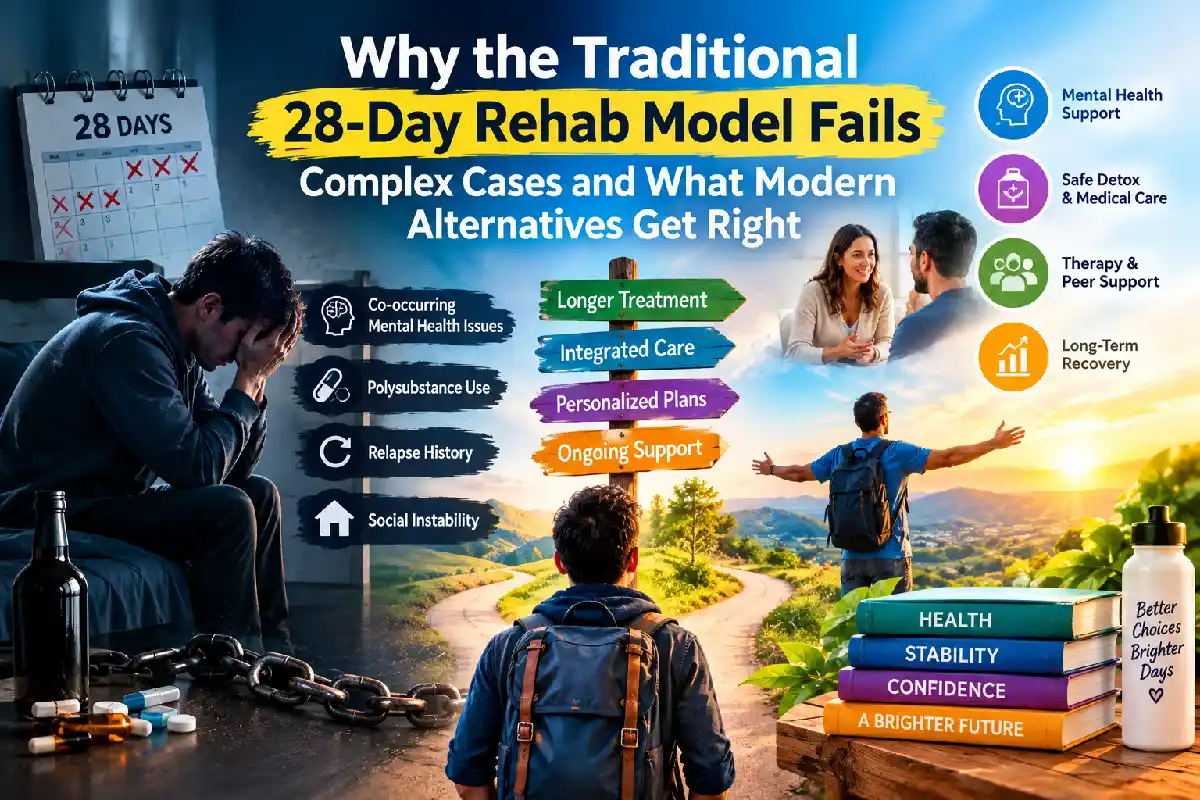
The 28-day model is predicated on the idea that a strong enough experience will trigger sustainable behavior change. But people have varying depths, and life below what most would consider their nadir can get pretty dark. What necessarily follows from that notion is the implicit acknowledgment by its proponents that certain prospective patients are, in essence, too sick to be treatable.
Where the 28-day number actually came from
This number dates back to the Minnesota Model, a treatment program created in the 1950s and ’60s at several Minnesota hospitals and subsequently broadened to include treatments at other abstinence-based inpatient programs. But the studies that called this approach a success weren’t particularly rigorous. They often didn’t include control groups and had high dropout rates. The studies that are well designed and randomized often didn’t see any difference between those treated as inpatients and those treated as outpatients. Or their results didn’t show a long-term advantage to the 28-day model.
One study randomly assigned a group of US veterans with alcohol use disorder either to inpatient treatment or to just receive a self-help book. Those in the inpatient program subsequently had more hospital admissions and other health care visits than those who weren’t. Or consider another recent study of Finnish men with chronic alcohol dependence. Those who only had a medical examination and advice to stop drinking saw similar mortality levels as those who were given access to more expensive, intensive care for their disorder. In other words, the 28-day treatment model’s benefits are dubious.
What “complex” actually means in addiction treatment
Not every case requires more than four weeks. However, nowadays, many people who seek treatment do not resemble the profile that the Minnesota Model had in mind. Co-occurring psychiatric conditions are the most glaring difference. A person managing depression, bipolar disorder, or PTSD while trying to recover from substance use needs – and in most cases will benefit most from – treatment that can address both problems. Someone with dual diagnosis must receive integrated psychiatric care that treats the whole person, not a mere addict, in a program that considers the interconnectedness of both problems. This means the person will receive medication management, psychiatric evaluation, and therapy that considers both conditions as linked, not sequential, problems. You can’t stabilize the addiction and then expect the depression to lift. They feed each other.
Polysubstance use is often another reasonable explanation. If you are trying to detox from both alcohol and benzodiazepines it is going to take longer and be far riskier than simply detoxing from one of both.
Then there is relapse history. If someone is on his third or fourth go-round, you don’t start from zero. You have first to peel away all the things that didn’t work, including the suspicions of family members and the grudging approval of friends, before you can start the really slow work of building something back up. They are not going to have as many new dopamine receptors as the first time they got sober. Let alone if they are dealing with opioids.
Then, finally, come the social destabilizations. Job loss, legal trouble, the breakup of a marriage, housing instability: those are real-time obstacles, and they become more severe as the stay becomes shorter and has less time to address any of them systematically.
The research says 90 days is the floor, not the ceiling.
The Principles of Drug Addiction Treatment from NIDA are very clear on this. Treatment of less than 90 days is of limited or no effectiveness for most patients. Referencing multiple scientific evaluations of treatment effectiveness, NIDA further states that “optimal outcomes are associated with treatment lasting substantially longer than 90 days.” It also directly refutes the idea that “those who do not achieve abstinence within the first 90 days should be referred to a different modality of treatment,” making it clear that the longer duration and incremental progress are not only beneficial but should be expected.
The cliff effect: where fixed timelines turn dangerous
This aspect of fixed-duration addiction treatment is not often brought up. The riskiest phase is not when someone is in treatment, but when they are done.
For a 28-day period, patients are taken out of the environment fueling their substance use, prescribed medications that take the edge off cravings, and surrounded by peers and professional staff focused on recovery. It’s imperfect and human and expensive, but it can help.
Then it stops. Every one of those protective factors disappears all at once. The patient transitions from a tightly proscribed daily routine with nearly every hour spoken for, to total open space. The stress and distractions that can limit the obsessiveness of cravings recede. The physical distances and locked doors between the patient seeking drugs and the drugs disappear.
And a brain that’s been chemically hijacked by substance use over years is supposed to find the wherewithal to navigate all that, with no further support. Small wonder that 40%-60% of patients relapse within the first year after treatment.
What assessment-driven treatment gets right
Contemporary programs that ditch the fixed-timeline model use a whole different operating logic: they base duration on clinical response, not on a date predetermined for reimbursement at intake. The ASAM (American Society of Addiction Medicine) criteria give clinicians a standardized way to do this. Instead of slotting someone for a flat number of days, ASAM assesses patients based on how urgently they need help in six categories: withdrawal risk, biomedical conditions, psychiatric status, whether they’re precontemplative/contemplative/already taking action on recovery, risk of relapse, and whether their home situation is stable.
All of these are factors where the answer might change from week to week; after all, someone who gets close to losing their job because they can’t manage their bipolar disorder might fit a different level of care next month than they do today. And the ASAM criteria plan for that: level of care and duration of stay are reassessed formally at regular intervals, rather than set in stone on day one and then easily forgotten somewhere at the back of the chart. In metropolitan treatment markets with a dense concentration of specialized providers, this kind of calibration is becoming the norm rather than the exception. Programs like Legacy Healing LA build treatment plans around ongoing clinical assessment instead of a predetermined countdown, which lets a patient with a more complicated presentation get the actual time their condition requires instead of the time a reimbursement schedule allows.
MAT needs more time than a short stay allows
The schedule for most short-term rehabs is generally some mix of individual therapy, group therapy, and psychoeducation (relapse prevention, identifying triggers, and so on); little or nothing in the way of recreation; and lots of free time, particularly on weekends. That last bit – free time – is often deeply countertherapeutic for people in early recovery. Idle time is one of the first things you want to strip from such a person’s day. Time itself seems to pass more slowly when you’re detoxing, as Billie Holiday, who knew from detoxing, reported. For someone accustomed to using alone in their apartment at night, a span of days or weeks or months without plans can feel like an eternity getting up and going to bed.
Insurance logic, not clinical logic, built this system
Let’s be honest about why 28 days was chosen as a standard: the insurance reimbursement encouraged that length, not to mention it’s a nice, round number. Treatment facilities came to meet the demands of the insurance and billing sectors, and 28 days somehow became an entrenched institutional memory that mutated into a physiological guideline.
This system contortion wasn’t some shadowy cover-up. It was just convenient for the bottom line. The research that would eventually disprove the 28-day standard didn’t exist at that time, so there was no reason to doubt how convenient it was all-around. It was 28-day treatment or four weeks, take it or leave it.
For insight into how treatment can evolve if we pass the 28-day method by, the chronic-care model of addiction makes a really solid outline. Addiction functions more like asthma than appendicitis – it’s an illness that requires continual management over a lifetime, not a one-time fix with a guarantor. We don’t expect someone with asthma to be “cured” after their first month of therapy and no longer need an inhaler. If we apply the same logic to addiction, the question of how long treatment should be shifts a lot.
What actually determines lasting recovery
What really matters is what occurs after the treatment program ends. Continuity of care, support from other program graduates, finding the right sober living situation, and bringing the family into the treatment and recovery process are the components that will ensure that what was gained early on doesn’t slip away. A 28-day stay doesn’t provide enough time for a program even to introduce those components, much less to establish enough of a routine for them to become possible parts of a patient’s ongoing care.
Programs based on a person-centered length of stay treat the continuing care of the patient as an integral part of treatment, not an abstraction handed over in someone’s discharge packet. Family sessions are scheduled while the patient is still in recovery. Appropriate sober living arrangements are made before the patient is discharged, not thrown together as an afterthought. Alumni programs become a resource for the patient to return to when things get rough, rather than leaving the patient to walk through the roughest months alone.
The question the patient and the family need to be asking is not, “How long is rehab?” but rather, “Whose interests does 28 days really serve?” Once you put that question on the table and answer it honestly, the path forward turns away from a one-size-fits-all calendar and heads instead up a trail of treatment based on the individual.